
The Internet has become a new battlefield for businesses seeking superpositions among their competitors and engaging the maximum number of customers towards their brands. The world population is quickly adopting the digital way of doing business and performing transactions, as they have agreed on the fact that the internet has proven to be the safest and easiest way of fulfilling their organizational goals.
Every day, many new apps and websites are launched with the aim of serving over 59% of the total world’s population that believes in using online technologies and remains connected to the World Wide Web all the time. A number of trending technologies, tools, platforms, and frameworks are significantly contributing towards creating beautiful websites. Since frameworks play an important role in building an efficient, robust, and effective website, people still remain confused as to which framework to choose for their website development requirements. The competition and huge demand among the most popular ones, Angular, React, and Vue, brings immense opportunities to the developers to build the finest product of their clients’s choice. Let’s check out which framework stands stronger against the other in this well-researched post. But before that, we will go through each one of them in detail, separately.
What is Angular?
Developed by Google, Angular was released in 2010 as a typescript-based framework that uses a regular DOM. The framework provides a set of tools for building a complex and reactive UI. It is basically an open-source framework that aims at creating SPAs, i.e., single-page applications, and is commonly used for building large-scale enterprise applications.
Providing a comprehensive set of web development tools, Angular performs routing, HTTP requests, form handling, and unit testing of applications. It comprises a vibrant community of developers and a large ecosystem of third-party libraries, along with some extensions that can be used for enhancing and extending the frameworks. Google Cloud Console and Upwork use Angular to provide a responsive experience to their members.
Advantages of Using an Angular Framework
- Use of TypeScript’s data types.
- Custom and reusable components. It allows the developers to create their own components.
- Productivity and consistency of code.
- Code reduction and efficient maintainability.
- High compatibility and easy testing.
What is React?
React, an open-source front-end library developed by Facebook in 2011, is used to create web and mobile applications. It is a popular JavaScript framework that helps in building user interfaces for all levels of organizations, including Facebook, GitHub, Reddit, and Airbnb.
React uses its virtual DOM as a lightweight representation of its actual DOM for efficiently updating and rendering components. When the state of a component changes, it just updates the necessary parts of the virtual DOM, further efficiently applying those changes to the actual DOM. This is a significant approach to improving performance and making React applications fast and responsive.
Advantages of Using the React Framework
- The framework is easy to learn.
- It helps in building a rich UI.
- It lets you write custom components.
- It uplifts the productivity of the developers.
- It offers fast rendering as well as testing of components.
- SEO-friendly and useful developer toolset
- Strong community support and toolkit support
- Availability of extensions and better code stability
- The framework is used by Fortune 500 companies.
What is VUE?
Evan You, an ex-Google employee and a leading software developer from Singapore, has also developed an open-source, front-end library like React that is used for creating web applications, but it is not a complete MVC framework. Though Vue is a progressive framework to build single-page web applications and user interfaces, it offers a simple and intuitive approach to web development, making it an excellent choice for developers.
Vue facilitates a combination of declarative templates and interactive web interfaces with reactive data binding that helps in creating dynamic and responsive applications without requiring complex coding and extensive configuration.
Advantages of Using the Vue Framework
- It automatically links the data to the DOM, takes care of configurations, and creates watchers for all components.
- Vue also follows component-based architectures like Angular and React, and Vue components are portable, reusable, and easily tested.
- Vue makes the UI component cohesive, portable, and maintainable.
- Its extremely lightweight and fastest framework ensures high performance for websites and apps with high page loading times and positive SEO rankings.
- It possesses extremely detailed documentation.
- Weex, created by Alibaba Group and incubated by Apache, facilitates cross-platform UI framework development.
- js and Bootstrap-Vue are provided as helpful external libraries and frameworks for developing a variety of web and mobile applications.
Comparing All Three Frameworks
As we have discussed all three frameworks and their advantages in detail, let’s compare them in detail to choose the best of them for building quality applications.
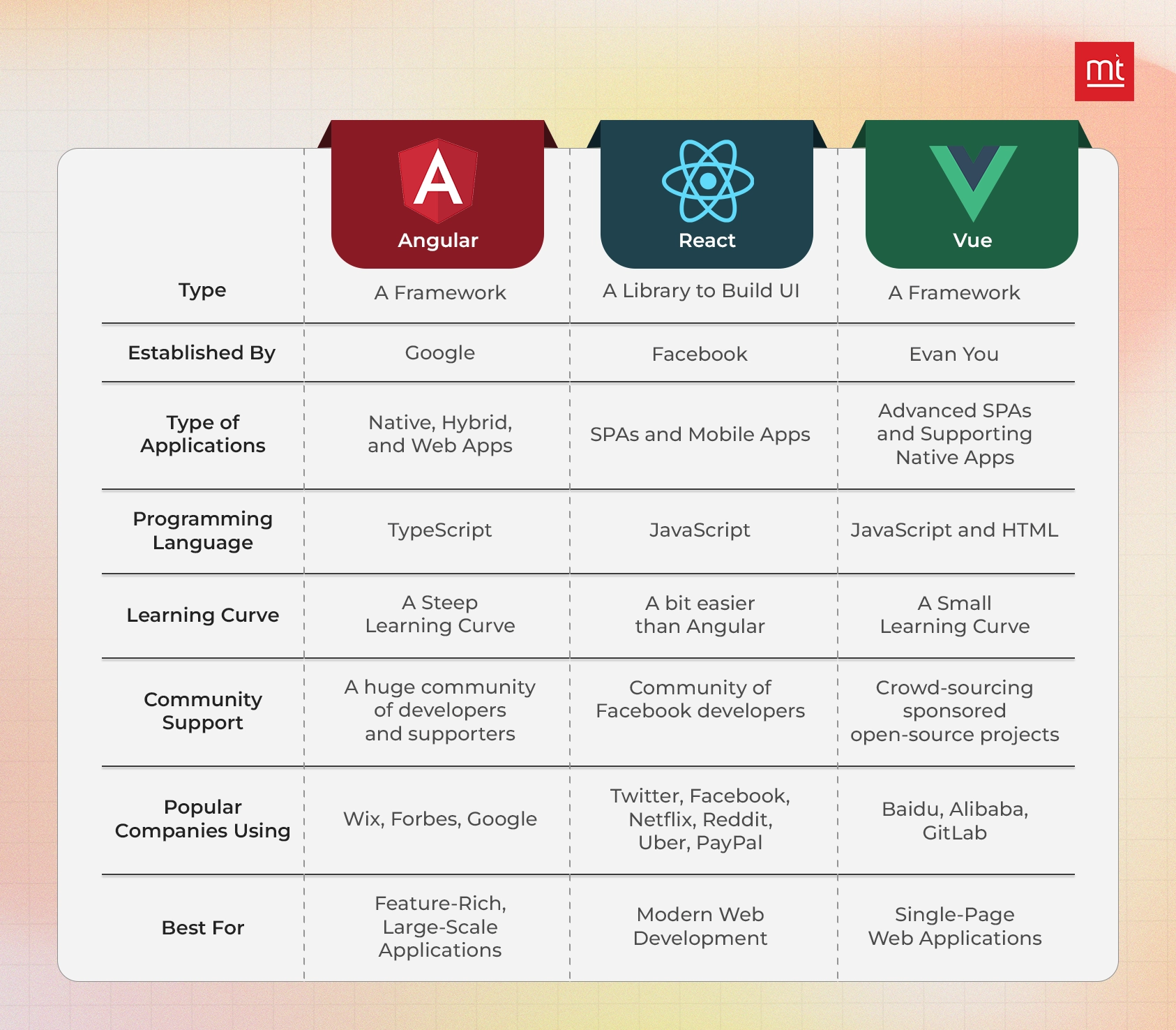
A Comparative Analysis between Angular, React, and Vue

#1. Popularity and Market Trends
Angular is a full-fledged framework, whereas React and Vue are lightweight libraries. For enterprise applications, Angular is a popular choice, whereas React and Vue are best to use for start-ups and small businesses. Angular comes with a wide adoption rate among a large community of developers. React and Vue generally have a smaller user base. In terms of market trends, Angular tops the chart, followed by React. Vue is also quickly growing in the market as a leading app development framework.

#2. Development Tools
Angular, React, and Vue all comprise a variety of development tools. Angular comes with a wide range of IDEs and extensions available, while React has a smaller selection, but it can still efficiently get the job done.
Vue also comprises a good selection of IDEs and extensions. Enterprises can select from the various options available, whereas start-ups and small businesses may rely on the lightweight options available to help them.
#3. Syntax
The syntax for all three languages is different. TypeScript is used in Angular as a superset of JavaScript. React uses JavaScript with JSX, which is an extension that allows embedding XML in the code. Vue uses HTML involving a particular attribute syntax. Entrepreneurs and businesses can use the syntax that efficiently meets their needs.
#4. Language
TypeScript is a superset of JavaScript that is used by the Angular framework. React uses JavaScript, and Vue can either use JavaScript or TypeScript. Each language has its own benefits and drawbacks. As a typed language, TypeScript can easily catch errors at the initial level, whereas the dynamic JavaScript language is easy to learn.
#5. Learning Curve
The Angular framework is fully equipped with various features that make it a bit challenging to learn for budding developers. A lightweight library, React is easy to learn but lacks some features that exist in Angular.
The progressive framework Vue brings a good balance between its features and learning curves. Beginners can learn it easily. In fact, it also has some advanced features for experienced developers.
#6. Ease of App Migration
The ease of app migration is one of the important considerations when opting for the JavaScript framework. This depicts how easy it is to migrate an existing app from one framework to another.
In terms of complexity, Angular, React, and Vue follow a challenging path. Vue is a bit compatible with other frameworks and libraries.
#7. Component-Based Architecture
The component-based architecture is important to consider when choosing a framework, as it enables easy reuse of the code when developing large-scale applications. Angular and React both have this feature, but it lacks in Vue. On the other hand, Vue provides support for the components, enabling the development of component-based applications using the Vue framework.
#8. Scalability
It is always important to consider the scalability of the framework when choosing one. This depicts how efficiently the framework can handle large-scale applications.
Generally, Angular and React are more scalable than Vue as they are designed for building applications for large-scale organizations. If properly designed, Vue can also serve the same purpose.
#9. Performance
All three frameworks are based on the Sift programming language. Angular benefits from facilitating server-side rendering, whereas React benefits in terms of its bundle size. Vue falls in the middle of these two. The best thing is the capability of all of these frameworks to deliver high-performing applications.
#10. Ecosystem
Each of these frameworks comprises a different ecosystem. Angular is a complete framework in itself that provides a large number of features and libraries. The lightweight library React focuses on the UI. The progressive framework Vue can be used for both small and large projects.

Which Framework to Choose from Angular, React, and Vue?
It is always important to consider all the crucial factors that are discussed above before selecting a JavaScript framework for your app development project. All the frameworks have their own benefits and drawbacks. Hence, you have to select the one that best suits your needs and requirements and helps you achieve your organizational goals.
Facilitating a wide range of features, Angular leads the charts as a full-fledged framework. Due to its lightweight nature and quick adoption ability, React is an easy-to-learn framework, and as a progressive framework, Vue uses its major capabilities to serve all small- to large-scale projects.
All of these frameworks are purely based on JavaScript. It means they are not dependent on any third-party tools. Every framework comprises unique features that can be used by the developers whenever they are required.
So, instead of reaching a conclusion about selecting a framework, it totally depends on which framework suits your needs. Thus, use the right framework based on your project requirements.
Frequently Asked Questions (FAQ)
Q.1. Which is the best framework to choose from Angular, React, and Vue?
A.1. Due to implementing its virtual DOM, React always performs faster. Vue is also an excellent performer, while the performance of Angular differs based on the implementation and complexity of the application.
Q.2. Which is the easiest to learn framework from Angular, React, and Vue?
A.2. Vue is regarded as the easiest framework to learn for budding developers. Simple syntax and approachable documentation make it an easy-to-learn framework. React is also a friendly framework for beginners, but the learning curve for Angular is a bit steeper.
Q.3. Which is the better framework for large-scale applications from Angular, React, and Vue?
A.3. Angular is generally preferred for building applications for large-level enterprises, as this framework comprises several built-in features to manage complex projects. React and Vue can definitely be used for large-scale applications, but they may need some additional libraries for certain functionalities.
Q.4. Which is the most popular framework among all of them?
A.4. React is a widely used framework, and the next place is taken by Angular and Vue in terms of popularity among developers.
Q.5. Which framework is used in building Netflix?
A.5. Netflix is a popular application used by the entire world. It uses Vue to enhance the process of software development.
Q.6. What should we learn out of those three?
A.6. For acquiring a quick-to-learn, easy-to-get-started, and straightforward framework, it is always better to choose React. But to acquire greater flexibility and complexity with the project you are making, you should always start working from scratch, i.e., start learning Vue.
Conclusion
As already discussed earlier, Angular, React, and Vue are all JavaScript-based frameworks that have equal importance for developing classy, user-oriented, and valuable applications for their users. Angular is a time-tested and robust solution; React is quick and flexible; and Vue is simple and high-performing. But the type of library or framework you need totally depends on your business demands and the vision you have for developing your web app. The best way is to go with finding the best web app development company when you are seeking assistance from experts.